
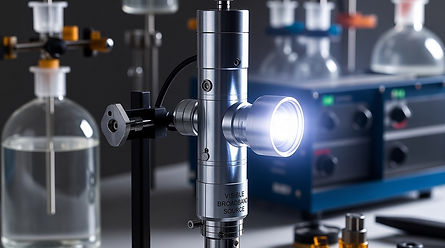
Visible Broadband Source
A Visible Broadband Source is a high-brightness, spatially coherent light source that emits a continuous (or quasi-continuous) spectrum spanning much of the visible range (~400–700 nm), often extending into the near-IR. It combines the spectral width of a lamp with laser-like beam quality, directionality, and brightness.
The dominant implementation is a fiber supercontinuum (SC) source.
How it is generated:
A pulsed pump laser (commonly 800 nm Ti:sapphire or ~1060 nm fiber/microchip laser, femtosecond to nanosecond pulses) is launched into a highly nonlinear medium—most often a photonic crystal fiber (PCF) or other specialty fiber.
Multiple nonlinear processes act together:
Self-phase modulation.
Four-wave mixing.
Soliton fission and Raman scattering.
Cross-phase modulation.
These processes massively broaden the spectrum while preserving a single spatial mode. Pumping in the anomalous-dispersion regime typically yields broader but noisier continua; all-normal-dispersion (ANDi) designs produce flatter, more coherent spectra at the cost of some bandwidth.
Commercial examples (NKT Photonics SuperK FIANIUM, COMPACT, EVO, etc.) typically cover 390–2400 nm with visible-band power from tens of mW to >2 W, single-mode output, and high long-term stability. Other approaches include fiber Cherenkov radiation sources, multi-SLD combinations, or frequency-doubled/swept NIR sources, but SC lasers are the most common “visible broadband source” in research and industry.
Key properties versus lamps or LEDs:
Spectral brightness orders of magnitude higher.
Diffraction-limited or near-diffraction-limited beam.
Fiber delivery possible.
Pulsed (useful for time-resolved work) or effectively CW after averaging.
Can be filtered, polarized, or made tunable with accessories.
Applications:
Visible-light optical coherence tomography (vis-OCT) — higher axial resolution and access to hemoglobin absorption for retinal oximetry.
Spectroscopy and hyperspectral imaging.
Confocal, multiphoton, and STED microscopy.
Fluorescence lifetime imaging and flow cytometry.
Photonic component characterization and test & measurement.
Semiconductor inspection.
Frequency metrology (when the SC is coherent enough to support a frequency comb).
Biomedical sensing and imaging where visible wavelengths provide molecular contrast that NIR sources lack.
The combination of laser-like spatial properties and lamp-like spectral coverage makes these sources especially useful wherever a single compact source needs to replace multiple discrete lasers plus a broadband lamp.