
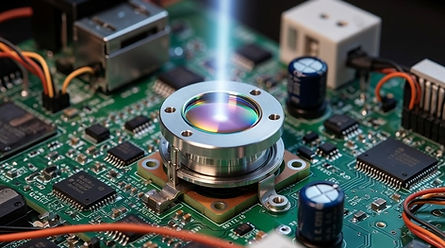
Vertical Cavity Surface Emitting Laser (VCSEL)
Vertical-Cavity Surface-Emitting Laser (VCSEL) is a semiconductor laser diode that emits light perpendicular to the surface of the chip (vertically out of the top face), in contrast to conventional edge-emitting lasers that emit from the side of the chip.
Technical Characteristics:
Structure: A short optical cavity (typically only a few micrometers long) formed between two highly reflective distributed Bragg reflector (DBR) mirrors grown epitaxially as alternating layers of semiconductor materials with different refractive indices. A thin active region (usually quantum wells or quantum dots) sits between the mirrors.
Emission: Light resonates vertically and exits through one of the mirrors (usually the top). The short cavity supports single-longitudinal-mode operation and produces a circular, low-divergence beam that is easier to couple into optical fibers than the elliptical beams of edge emitters.
Materials and wavelengths: Commonly based on GaAs/AlGaAs for near-infrared wavelengths (≈850 nm is the most widespread; also 780–980 nm and longer wavelengths with different material systems).
Key performance traits:
Low threshold current.
High modulation bandwidth (multi-GHz).
Array manufacturability (2-D arrays of many VCSELs on a single chip).
Relatively temperature-stable wavelength.
On-wafer testing possible before dicing (lower cost).
Main Applications in Photonics and Lasers:
High-speed optical data links and interconnects — Dominant source for short-reach multimode-fiber links in data centers, high-performance computing, and consumer electronics (e.g., USB, Thunderbolt, HDMI optical cables) at 850 nm.
3-D sensing and imaging — Structured-light and time-of-flight modules for facial recognition (smartphone security), gesture recognition, and depth sensing.
LiDAR and automotive sensing — Arrays used in solid-state or hybrid LiDAR systems for distance measurement and environmental mapping.
Optical mice, laser printers, and barcode scanners — Compact, efficient sources.
Medical and biomedical — Certain sensing, illumination, and low-power therapeutic uses.
Emerging uses — Atomic clocks, quantum sensing, optical wireless (Li-Fi-type links), and co-packaged optics.
VCSELs combine the efficiency and modulation speed of semiconductor lasers with surface-normal emission and easy array integration, making them a key photonic component for short-reach communications and compact sensing systems.