
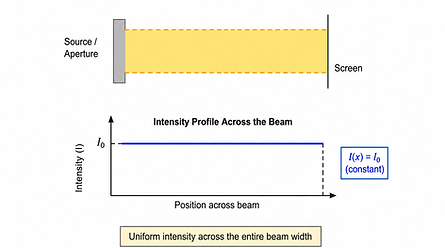
Uniform Intensity Distribution
Uniform Intensity Distribution (also called a "flat-top" beam) refers to a laser beam where the optical power (intensity) is roughly constant across the beam's cross-sectional area, rather than peaking strongly in the center and tapering off at the edges.
Contrast with Typical Laser Beams:
Most lasers naturally produce beams with a Gaussian (or near-Gaussian) intensity profile. In a Gaussian beam:
Intensity is highest at the center and falls off exponentially toward the edges.
This is mathematically described as: I(r) = I₀ × exp(−2r²/w²), where I₀ is peak intensity, r is radial distance from center, and w is the beam radius (at 1/e² intensity).
Gaussian beams are excellent for applications requiring tight focusing to a small diffraction-limited spot (e.g., laser cutting, microscopy, or optical trapping) because the energy concentrates centrally.
However, for tasks needing even energy delivery or illumination across an area, the non-uniform Gaussian profile causes problems: the center overheats or overexposes while edges receive less energy. A uniform intensity distribution solves this by delivering nearly constant intensity within the desired area, with a sharp drop-off at the edges.
Technical Information:
Ideal flat-top profile: Intensity is constant inside a circular, square, or rectangular aperture and near-zero outside. Real-world versions are approximations with some ripple (typically <10–20% variation) due to diffraction and optical imperfections.
Common metrics:
Top-hat uniformity: Often quantified as (max – min)/(max + min) or standard deviation across the flat region.
Edge steepness: How quickly intensity drops at boundaries (affected by diffraction limits).
Methods to create uniform beams (beam shaping in photonics):
Refractive beam shapers (e.g., πShaper, aspheric lens pairs): Convert Gaussian to flat-top via careful ray redistribution.
Diffractive optical elements (DOEs): Phase plates or gratings that reshape the wavefront.
Homogenizers: Fly-eye lens arrays, microlens arrays, or integrating rods that average the beam through multiple overlapping images.
Fiber-based or multimode approaches: Using multimode fibers or diffusers for partial homogenization.
Adaptive optics: Liquid crystal or deformable mirrors for dynamic control.
These techniques preserve total power while redistributing it spatially. Efficiency varies (typically 70–95%), and the resulting beam may have a larger divergence or require specific input beam quality (M² factor close to 1 for best results).
Photonics Applications:
Uniform intensity distribution is particularly valuable wherever even illumination or processing over an area is critical. Using the provided definition:
Material Processing: Ensures uniform heating, ablation, or modification across the entire spot. Examples include:
Laser annealing (e.g., semiconductor or thin-film processing).
Laser marking, engraving, or micromachining of large areas without "hot spots."
Surface texturing or welding where consistent depth/energy delivery matters.
Illumination and Imaging:
Machine vision and inspection: Uniform lighting makes defects or features equally bright regardless of position in the field of view. This simplifies algorithms, improves contrast, and enhances resolution/accuracy in automated inspection systems.
Flow cytometry: Uniform illumination of cells passing through the laser beam produces consistent fluorescence signals, leading to better data quality and cell sorting precision.
Broader Lighting Applications (as noted):
Scientific and industrial illumination.
Medical uses: Photodynamic therapy, skin treatments, or retinal imaging where even dosing prevents under- or over-exposure.
Microscopy and spectroscopy: Homogeneous excitation for quantitative measurements.
Additional key photonics applications:
Photolithography and semiconductor manufacturing: Uniform exposure for consistent feature sizes across wafers.
Laser pumping: Uniform illumination of gain media (e.g., in solid-state lasers) for efficient, symmetric output.
Holography and interferometry: Reduces unwanted intensity variations in recorded patterns.
Display and projection systems: Even backlight or laser illumination for uniform brightness.
Optical testing and metrology: Flat-top beams in interferometers or profilometers for accurate surface measurements.
In summary, while Gaussian beams dominate focusing applications, uniform (flat-top) intensity distribution is engineered for scenarios demanding spatial consistency. This makes it a foundational tool in modern photonics for precision manufacturing, high-throughput imaging, and quantitative optical techniques. Advances in beam-shaping optics continue to make flat-top beams more accessible, efficient, and customizable in wavelength, size, and shape.