
Photodiode Integration
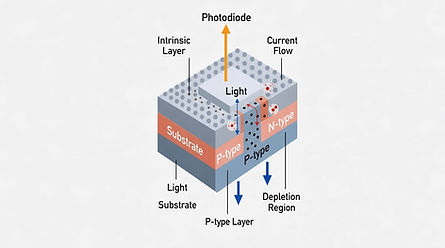
Photodiode integration refers to the incorporation of one or more photodiodes (semiconductor photodetectors, typically PIN or avalanche types) directly with laser sources, waveguides, or other photonic components—either monolithically on the same chip/substrate, heterogeneously via bonding or hybrid assembly, or within the same package—for power monitoring, feedback control, signal detection, or complete transceiver functionality.
Technical Information:
A photodiode converts incident light into electrical current via the photoelectric effect in a p–n or p–i–n junction (often under reverse bias). Key parameters include responsivity (A/W), bandwidth (from MHz to >100 GHz for high-speed devices), dark current, capacitance, and quantum efficiency. Materials are chosen by wavelength: silicon for visible/~850–1000 nm, InGaAs or Ge for near-IR telecom bands (~1310–1550 nm), with germanium-on-silicon common in silicon photonics.
Integration approaches include:
Monolithic: Growing or fabricating the photodiode and laser (e.g., VCSEL or edge-emitting diode) on the same epitaxial structure or wafer, sometimes with a monitor photodiode detecting light through a partially transmitting rear facet or via a tap coupler.
Heterogeneous / hybrid: Bonding III–V photodiodes (e.g., InGaAs/InP) onto silicon or silicon-nitride photonic platforms, or integrating Ge photodiodes with silicon waveguides for CMOS-compatible photonic integrated circuits (PICs).
Package-level: Placing a discrete monitor photodiode inside a laser diode TO-can or butterfly package to sample output power.
In silicon photonics and PICs, waveguide-coupled (evanescent or butt-coupled) photodiodes enable on-chip detection with low parasitics, supporting multi-GHz to tens-of-GHz operation. Challenges involve material incompatibilities (lattice mismatch, thermal budgets), optical coupling efficiency, thermal management, and maintaining high bandwidth/responsivity while minimizing crosstalk or capacitance.
Applications:
Laser power monitoring and feedback control: A rear-facet or on-chip monitor photodiode (MPD) provides a signal proportional to laser output for automatic power control (APC) loops, stabilizing intensity against temperature or aging drifts. Common in laser diodes and VCSELs.
Optical communications and data centers: Integrated photodiodes in transceivers and PICs convert modulated optical signals back to electrical form at high data rates (e.g., 25–100+ Gb/s lanes). Co-packaged or co-integrated optics benefit from reduced size, power, and cost.
Silicon photonics and photonic integrated circuits: Ge or III–V photodiodes complete the optical link on-chip alongside modulators, waveguides, and (heterogeneously integrated) lasers for interconnects, sensing, and computing.
Sensing, LiDAR, and metrology: Arrays or single integrated photodiodes (including APDs/SPADs) for ranging, spectroscopy, OCT, or balanced detection schemes that reject common-mode laser noise.
Microwave/mmWave photonics and advanced sources: High-speed photodiodes integrated with microcombs or mode-locked lasers for photonic generation of RF/mmWave signals via direct detection of optical pulse trains.
Bidirectional links and compact modules: Monolithic VCSEL + photodiode pairs for single-fiber duplex transmission or self-monitoring devices.
Overall, photodiode integration is essential for compact, reliable, high-performance photonic systems, enabling closed-loop control and full optical-to-electrical conversion without bulky discrete components.