
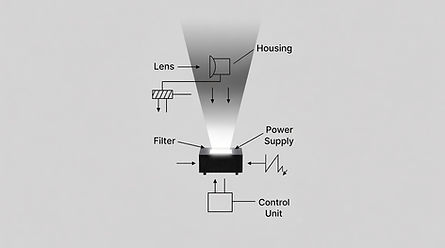
Near Infrared Light Source (NIR Light Source)
Near Infrared (NIR) Light Source refers to any device that generates electromagnetic radiation in the near-infrared portion of the spectrum, typically just beyond visible red light. In lasers and photonics, this term covers coherent sources (lasers) and incoherent/broadband sources (LEDs, phosphor-converted devices, thermal emitters, or laser-pumped phosphors).
Wavelength Range:
Definitions vary slightly by field and standard:
Common photonics/laser range: ≈ 750–1400 nm (sometimes extended to ~2000 nm).
ASTM and broader NIR spectroscopy definitions: 780–2526 nm, often subdivided into short-wavelength NIR (≈780–1100 nm) and longer NIR (1100–2526 nm).
Related bands: Short-wave infrared (SWIR) often starts around 1400–3000 nm.
NIR radiation is invisible to the human eye (or only faintly visible as a deep red glow at the shortest wavelengths). It interacts usefully with many materials via overtones and combination bands of molecular vibrations (especially C–H, O–H, N–H).
Technical Information:
Common source types in lasers & photonics:
Semiconductor laser diodes (most common): Fabry–Pérot, distributed feedback (DFB), distributed Bragg reflector (DBR), VCSELs. Materials include GaAs-based (shorter NIR, e.g., 705–900 nm) and InP-based (longer wavelengths to ~2000 nm). Output powers range from mW (telecom, sensing) to multi-watt or kW-class stacks (pumping/materials processing).
Solid-state and fiber lasers: Nd:YAG (~1064 nm), various rare-earth doped fibers, diode-pumped systems.
LEDs and phosphor-converted LEDs (pc-LEDs): Narrowband (e.g., peaks at 850 nm, 940 nm) or broadband. Emerging high-power laser-driven phosphor sources (e.g., blue-laser-pumped MgO:Cr³⁺ ceramics emitting broadband around 810 nm with >6 W output).
Other: Supercontinuum sources, optical parametric oscillators, or integrated silicon photonic emitters for on-chip use.
Key technical characteristics:
Coherence: Lasers provide high spatial/temporal coherence, narrow linewidths (important for spectroscopy, interferometry, telecom); LEDs/broadband sources are incoherent and wider bandwidth.
Beam quality and efficiency: Diode lasers can be compact and efficient; high-power versions often multimode.
Detection compatibility: Silicon detectors work well up to ~1000–1100 nm; longer wavelengths need InGaAs or other materials.
Eye safety note: NIR is particularly hazardous because it is focused by the eye onto the retina like visible light but does not trigger the blink reflex.
Applications:
NIR light sources are foundational across photonics due to good atmospheric/fiber transmission windows, tissue penetration (“therapeutic window”), and molecular absorption features:
Telecommunications & optical communications: 1310 nm and 1550 nm windows (C- and L-bands) for low-loss fiber transmission.
Sensing, spectroscopy & metrology: NIR spectroscopy for composition analysis (moisture, proteins, fats in food/agriculture/pharma); gas sensing; LiDAR (often 850–1550 nm).
Biomedical & medical: Tissue imaging, photobiomodulation, photodynamic therapy, non-invasive sensing (e.g., blood oxygen), surgical lasers (select wavelengths for water/hemoglobin absorption).
Imaging & security: Night vision, surveillance, face recognition, machine vision (850/940 nm illumination invisible or low-visibility to humans).
Industrial processing & pumping: High-power diodes (808 nm, 940 nm, 980 nm, etc.) as pump sources for solid-state/fiber lasers; materials processing (welding, cutting, cladding).
Emerging/advanced: Quantum technologies, on-chip integrated photonics, broadband sources for hyperspectral imaging, and high-brightness laser-phosphor systems for compact NIR illumination.
An NIR light source in lasers and photonics is a versatile emitter in the ~0.75–2 µm range that enables applications ranging from everyday fiber-optic networks and night-vision cameras to precision medical and scientific tools. The choice of source (laser vs. LED/broadband, specific wavelength, power, and coherence) is driven by the requirements of penetration depth, spectral resolution, power density, and cost.