
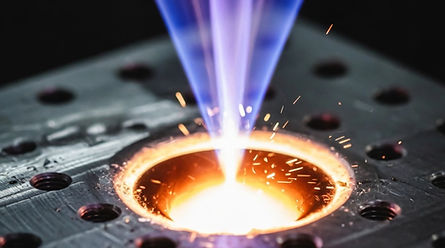
Keyholing
Keyholing: (also called keyhole welding or deep-penetration laser welding) is the standard technical term for the phenomenon you described—almost certainly what was intended by “Keyholding,” which appears to be a minor spelling variant or typo based on welding literature.
Expanded Definition:
In laser welding, keyholing occurs when a high-intensity focused laser beam strikes a metal surface and rapidly vaporizes the material, creating a transient, vapor-filled capillary (a narrow “keyhole” or deep-penetration hole). Unlike conventional welding, which relies on surface heat conduction to create a shallow melt pool, keyholing produces deep, narrow welds with a high depth-to-width aspect ratio (often >1.5:1 and sometimes exceeding 10:1). The keyhole is not a permanent slot; it is dynamic. As the laser moves along the joint (or the pulse ends), the surrounding molten metal flows back in under surface tension and hydrostatic pressure, quickly filling and solidifying the cavity—often in just a few milliseconds in pulsed-laser modes. This results in strong, low-distortion welds with minimal heat-affected zones.
The process typically requires a laser power density above roughly 1.5 MW/cm² (and often >10⁶ W/cm²). Below this threshold, the weld stays in “conduction mode” (shallow and wide); above it, keyholing engages.
Relation to Photonics, Lasers, and Physics:
Keyholing is a textbook example of photon–matter interaction at extreme intensities and sits at the intersection of photonics, laser engineering, and fluid/plasma physics.
Photonics and lasers: Photonics is the science of light (photons). Lasers—coherent, monochromatic, high-brightness light sources—are the enabling photonic devices. Modern keyhole welding commonly uses fiber lasers, disk lasers, or high-power diode lasers because photonics allows them to be focused to tiny spots (often <0.2 mm) while delivering kilowatts of continuous or pulsed power. The beam can be delivered via flexible optical fibers, and beam-shaping optics (another photonic technology) control the exact intensity profile. This precision is impossible with traditional arc or electron-beam welding.
Core physics:
Absorption and heating: Incident laser photons are first absorbed at the surface (via Fresnel absorption). At high intensity, the metal melts and then vaporizes in microseconds.
Keyhole formation: Vapor atoms evaporate at high speed, imparting recoil pressure on the molten pool (like a rocket exhaust pushing backward). This pressure “drills” the vapor cavity downward.
Multiple reflections and trapping: Inside the keyhole, the walls are nearly vertical; laser rays bounce repeatedly (multiple Fresnel reflections), dramatically increasing energy coupling efficiency—often from ~10–20 % on a flat surface to nearly 100 %.
Hydrodynamics and stability: The keyhole is held open by vapor/plasma pressure against surface tension, gravity, and molten-metal flow. Complex convection (Marangoni effect driven by surface-tension gradients) circulates the melt around the keyhole. In pulsed operation, the entire cycle—formation, propagation, and collapse—can occur in milliseconds.
Plasma effects: At very high powers, a metal-vapor plasma forms inside the keyhole; photons can be further absorbed via inverse Bremsstrahlung, adding another photonic absorption channel.
In short, keyholing transforms laser light (photons) into a self-sustaining, high-aspect-ratio energy-delivery conduit inside the material.
Real-World Applications:
Keyhole laser welding is prized for speed, precision, deep penetration in a single pass, and low distortion—making it indispensable in high-volume or high-performance manufacturing:
Automotive industry — Welding car-body tailored blanks (different-thickness steel sheets), powertrain components (gearboxes, torque converters), and electric-vehicle battery tabs/packs. The process joins thick sections at speeds >20 inches per second with minimal heat input, preserving material strength.
Aerospace and defense — Joining titanium alloys, turbine blades, and structural airframe parts. The deep, narrow welds reduce weight and distortion in critical flight components.
Shipbuilding and heavy fabrication — Welding thick steel plates (up to tens of millimeters) in ship hulls or pipelines. Diode-laser keyhole welding produces clean seams with low spatter.
Electronics and medical devices — Precision micro-welding of stainless steel or copper where minimal heat-affected zones are essential (e.g., pacemakers, sensors, or hermetic seals).
Emerging uses — High-power fiber-laser keyhole welding of copper in EV batteries (copper is highly reflective, yet keyholing overcomes this) and additive-manufacturing repair of high-value parts.
Keyholing has revolutionized manufacturing by turning a photonic tool (the laser) into a high-speed, deep-penetration “drill” that self-seals with molten metal. It remains a cornerstone of modern photonics-driven joining technology.