
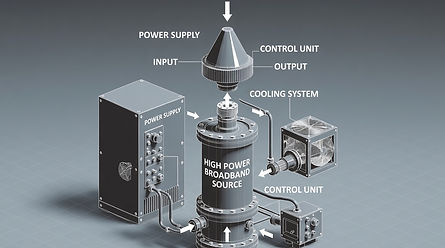
High Power Broadband Source
A high-power broadband source in lasers and photonics is an optical emitter that delivers substantial average (or peak) power while covering a wide spectral range—typically tens of nanometers to well over an octave—rather than a single narrow laser line.
It combines lamp-like spectral coverage with laser-like spatial brightness, beam quality, and often fiber delivery. “High power” is context-dependent: tens of milliwatts to tens of watts for lab/test sources, and hundreds of watts to kilowatts for industrial or research systems. “Broadband” usually means a continuous or quasi-continuous spectrum far wider than a typical laser linewidth.
Two dominant implementations are supercontinuum (SC) sources and amplified spontaneous emission (ASE) / superfluorescent fiber sources.
Supercontinuum sources:
A pulsed pump laser (often a picosecond or femtosecond Yb- or Er-doped fiber laser near 1 µm or 1.55 µm) is launched into a highly nonlinear fiber—commonly a photonic-crystal fiber (PCF) or other dispersion-engineered waveguide. Nonlinear effects (self-phase modulation, soliton fission, four-wave mixing, Raman scattering) broaden the spectrum into a continuous “white-light” output.
Typical commercial specs:
Spectrum: ~400–2400 nm in silica fiber (visible through near-IR); mid-IR versions use fluoride or other fibers and can reach ~4–5 µm.
Average power: several watts is common; research systems have reached tens of watts and, in specialized all-fiber Yb-amplifier schemes, hundreds of watts (e.g., ~714 W spanning ~690–2350 nm).
Beam: single-mode, near-diffraction-limited, fiber-delivered.
Pulse format: usually MHz-repetition-rate picosecond pulses; CW-pumped variants also exist.
ASE / superfluorescent sources:
Rare-earth-doped fiber (Yb, Er, Tm, Ho, etc.) is pumped so that spontaneous emission is strongly amplified without forming a resonant laser cavity. The result is temporally incoherent, low-coherence light with a relatively smooth, broad spectrum set by the gain bandwidth.
Typical specs:
Telecom C/L-band ASE: tens of mW to multi-watt levels over ~80 nm.
1 µm Yb ASE / SFS: tens of mW to kW-class after MOPA amplification, with linewidths from a few nm to tens of nm.
2 µm Tm/Ho ASE: tens of mW to >10 W over tens to >100 nm.
Advantages: high temporal stability, short coherence length, no mode-beating, good for interferometry and as seeds that raise SRS/TMI thresholds in high-power amplifiers.
Other related approaches include laser-pumped broadband phosphors/ceramics (watt-level NIR with high conversion efficiency) and amplified soliton microcombs that put milliwatt-to-watt-level power on many discrete but densely spaced lines across 100+ nm.
Applications:
Spectroscopy and sensing: absorption, fluorescence, and hyperspectral measurements; gas sensing; component characterization (filters, fibers, gratings).
Imaging: optical coherence tomography (OCT), confocal and multiphoton microscopy, fluorescence lifetime imaging, flow cytometry.
Metrology and communications: frequency-comb seeding, multi-wavelength WDM test sources, coherent transmission experiments (especially O-band microcombs).
Device testing and process monitoring: broadband illumination for inspection, inline metrology.
High-power laser engineering: low-coherence seeds for kW-class fiber amplifiers (better SRS and TMI behavior than narrow-line seeds); pump or probe sources for nonlinear optics.
Emerging uses: mid-IR spectroscopy, chip-scale integrated SC, LIDAR/hyperspectral remote sensing, and biomedical diagnostics.
Trade-offs include spectral flatness vs. power, noise (SC sources can be noisy unless designed for low relative intensity noise), coherence properties (ASE is low-coherence; SC can retain pulse structure), and thermal/nonlinear limits when scaling power. Choice of technology depends on whether the application needs a continuous spectrum, discrete comb lines, short pulses, or simply high spectral density over a given band.