
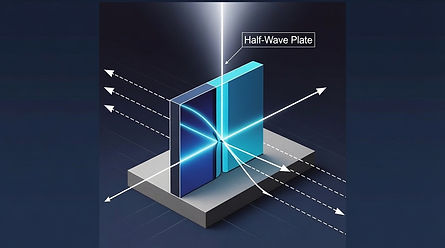
Half-Wave Plate
Half-Wave Plate (λ/2 Plate)
Definition:
A half-wave plate is a birefringent optical component that introduces a phase difference of π radians (180° or λ/2) between the two orthogonal polarization components (ordinary and extraordinary rays) of light passing through it.
Its primary effect on linearly polarized light is to rotate the plane of polarization by an angle of 2θ, where θ is the angle between the incident polarization direction and the fast axis of the waveplate.
Technical Information Operating Principle:
Light enters a birefringent crystal (which has two different refractive indices: nₑ (extraordinary) and nₒ (ordinary)).
The component aligned with the fast axis (lower refractive index) travels faster than the component along the slow axis.
The plate thickness d is precisely chosen so that the optical path length difference produces exactly λ/2 retardation at the design wavelength:
δ={2π/λ} d (ne−no) = π ⇒ d = λ/2(ne−no)
Key Specifications:
Material: Quartz (most common), Magnesium Fluoride (MgF₂), Calcite, Sapphire, liquid crystal polymers, or polymer films.
Wavelength Range: Typically designed for a specific wavelength (e.g., 532 nm, 1064 nm, 1550 nm). Broadband versions exist but have reduced performance.
Retardation Accuracy: Usually ±λ/300 or better for high-quality plates.
Clear Aperture: From a few mm to several inches.
Damage Threshold: High-power laser versions (e.g., quartz) can handle >10 J/cm² for ns pulses.
Anti-Reflection Coatings: Essential to reduce losses (R < 0.2% per surface).
Temperature Sensitivity: Quartz is relatively stable; some materials shift retardation with temperature.
Behavior Summary (Half-Wave Plate):
Linear polarization (at an angle θ to the fast axis) → Output: Linear polarization rotated by 2θ→ Use: Polarization rotation
Linear polarization (aligned with fast or slow axis) → Output: Linear polarization (unchanged) → Use: No effect
Circular polarization→ Output: Circular polarization with opposite handedness→ Use: Handedness reversal
Elliptical polarization→ Output: Elliptical polarization (transformed) → Use: Polarization control
Note: A half-wave plate does not convert linear polarization to circular polarization (a quarter-wave plate is required for that).
Photonics and Laser Applications:
Half-wave plates are fundamental components in laser systems and photonics due to their ability to precisely control polarization with minimal loss.
Laser Systems:
Polarization Control: Rotate the polarization of laser output to match downstream optics (e.g., aligning with Brewster windows or Pockels cells).
Laser Cavity Tuning: Used inside resonators to control polarization state, suppress unwanted modes, or optimize gain in anisotropic crystals (Nd:YAG, Ti:Sapphire).
High-Power Laser Chains: Rotate polarization between amplifier stages to compensate for thermally induced birefringence.
Mode-Locking & Ultrafast Lasers: Combined with polarizers for saturable absorber alignment or pulse picking.
Optical Isolators & Circulators:
Essential in Faraday isolators: A half-wave plate is often used to adjust the input/output polarization to achieve maximum isolation (>40–60 dB).
Interferometry & Sensing:
Mach-Zehnder, Michelson, and Sagnac interferometers: Control polarization to maintain fringe visibility and reduce noise.
Polarimetric Sensors: Fiber-optic current/voltage sensors, strain sensors.
Telecommunications & Fiber Optics:
Polarization controllers in fiber networks.
Polarization-division multiplexing (PDM) systems.
Testing and characterization of polarization-maintaining (PM) fiber.
Quantum Optics & Photonics:
Preparing specific polarization states for quantum information processing.
Entanglement experiments.
Single-photon sources and detectors.
Imaging & Microscopy:
Polarization-sensitive imaging.
Confocal and multiphoton microscopy.
Ellipsometry.
Industrial Laser Applications:
Laser marking, cutting, and welding: Optimize polarization for material interaction (e.g., p-polarization for higher absorption on metals).
Laser micromachining.
Directed Energy / LIDAR systems.
Common Combinations:
Half-wave + Quarter-wave plate → Full polarization state generator/analyzer.
Half-wave plate + Polarizer → Variable attenuator (intensity control).
Rotatable motorized half-wave plate → Dynamic polarization control.
Practical Tips -
Always align the fast axis properly (often marked on the mount).
For broadband use, zero-order or multi-order compound plates are preferred over simple multi-order plates.
At high power, use air-spaced or low-absorption materials to avoid thermal lensing.