
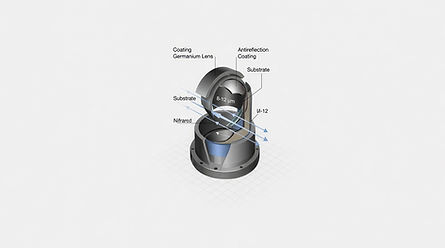
Germanium Infrared Optics
Germanium infrared optics are lenses, windows, prisms, filters, and other components made from crystalline germanium (Ge) that transmit mid-wave and long-wave infrared light while blocking visible light. They are a standard material in lasers and photonics for thermal imaging and IR laser systems because germanium is transparent from about 1.8–2 µm to 14–16 µm (sometimes quoted to ~23 µm) and has a very high refractive index.
That combination covers the two main atmospheric windows used for thermal sensing: 3–5 µm (MWIR) and 8–12/14 µm (LWIR).
Why germanium is used:
Germanium is a semiconductor (band gap ~0.67 eV) that absorbs visible and near-IR photons but transmits longer-wavelength IR. Uncoated pieces look metallic-gray and opaque to the eye; they act as a natural long-pass filter above ~2 µm.
Key optical properties:
Refractive index ≈ 4.00–4.01 at 8–12 µm (e.g. ~4.003–4.005 at 10.6 µm). This is the highest among common IR materials, so designers can use fewer, thinner, more compact elements with strong focusing power and relatively low chromatic aberration in a given band.
Uncoated transmission is only ~46% per window (two surfaces) because Fresnel reflection is ~36% per surface. AR coatings (often 3–5 µm, 8–12 µm, or 10.6 µm) raise transmission to ~90–98% in the design band. Hard diamond-like carbon (DLC) coatings are common on exposed faces for abrasion and weather resistance.
Absorption at 10.6 µm is typically ≤0.02 cm⁻¹ (mono) to 0.02–0.035 cm⁻¹ (poly) at room temperature for optical-grade n-type material (resistivity often 5–40 Ω·cm).
dn/dT is large (~4×10⁻⁴ /K), so focus and index shift with temperature. Transmission also drops with heat (“thermal runaway”): usable roughly up to ~45–70 °C for many imaging systems; absorption rises sharply and the material becomes nearly opaque around 100–200 °C. Cooling or athermalized designs are needed for high-power or hot environments.
Mechanical/thermal notes: density ~5.32–5.33 g/cm³ (heavy), Knoop hardness ~780 (harder than ZnSe), insoluble in water, chemically fairly inert, diamond-turnable. Mono- and polycrystalline grades exist; optical homogeneity (Δn) is specified tightly for imaging lenses.
Relation to lasers and photonics:
Germanium is used both as passive imaging optics and as laser optics, especially around CO₂ lasers at 10.6 µm, where absorption can be kept low enough for moderate power densities if the optic is cooled. It also appears in quantum-cascade laser (QCL) systems, FTIR spectrometers, and other IR photonic instruments. High n makes it useful for compact focusing optics and some ATR (attenuated total reflection) elements. It is not the first choice for the highest-power CW CO₂ beams; ZnSe usually has lower absorption and better thermal behavior there.
Silicon is often preferred in MWIR (3–5 µm) because it is lighter and cheaper and Ge has less advantage there; Ge dominates many LWIR (8–12 µm) thermal systems.
Typical applications:
Thermal imaging / FLIR cameras, night vision, surveillance, firefighting, industrial thermography.
Military and dual-use: weapon sights, targeting pods, missile seekers, vehicle/aircraft windows and domes, EMI-shielded IR ports.
CO₂ laser windows, lenses, and beam-delivery optics (moderate power).
FTIR and other IR spectrometers, gas sensors.
Biomedical and scientific IR imaging.
Interference-filter substrates and long-pass filters.
Limitations that drive material choice: cost and supply (germanium is a critical material with concentrated production), weight, temperature sensitivity, and the need for AR/DLC coatings.
Alternatives include silicon (MWIR), ZnSe/ZnS (broader band, often better for high-power lasers), and chalcogenide glasses (moldable, sometimes more athermal). Germanium remains the workhorse when compact LWIR performance and hardness matter most.