
Gaussian Beam
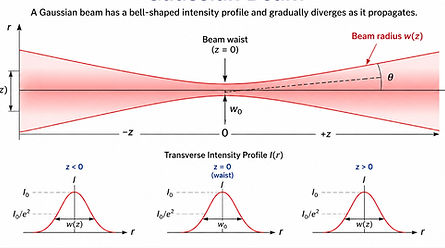
A Gaussian laser beam refers to an idealized beam of light (electromagnetic radiation), whose transverse electric-field amplitude and intensity distribution follow a Gaussian function—the classic “normal curve” or normal (bell-shaped) distribution from statistics. In the context of lasers, this profile appears in the fundamental transverse electromagnetic mode (TEM₀₀), which is the most common and desirable output of many laser resonators.
The intensity I(r) at a radial distance r from the beam’s central axis is given by:
I(r)=I0exp(−2r2w2)
where I₀ is the peak intensity at the center and w is the beam radius (defined at the 1/e² intensity point, or about 13.5% of peak). This means roughly 86% of the total energy lies within the 1/e² radius, with intensity falling off exponentially outward.
The original definition highlights a practical demonstration: when an uncorrected, unfocused laser in its optimum TEM₀₀ mode strikes a surface (e.g., metal or polymer), the energy distribution creates symmetrical bell-shaped ablation craters or holes—directly mirroring the normal curve because the central high-intensity region removes material fastest while the edges taper off gently. Unlike flat-top or multimode beams, a true Gaussian beam concentrates most of its energy in the center, diverges minimally, and can be focused to the smallest possible (diffraction-limited) spot size for a given wavelength. It remains a Gaussian profile after passing through ideal lenses or during free-space propagation (within the paraxial approximation).
Basic Technical Principles:
TEM₀₀ Fundamental Mode and Gaussian Solution to the Wave Equation: In a stable laser cavity, the lowest-order transverse mode (TEM₀₀) naturally satisfies the paraxial Helmholtz equation. This produces a smooth, radially symmetric Gaussian intensity profile with no nodes or phase discontinuities across the beam (unlike higher-order Hermite-Gaussian modes). The profile is preserved during propagation, making it the most stable and predictable beam shape available from lasers.
Diffraction-Limited Propagation and Beam Parameters: An ideal Gaussian beam has an M² beam-quality factor of exactly 1 (the theoretical minimum). It is fully described by just two parameters at any point: the beam waist radius w₀ (narrowest point) and the Rayleigh range z_R (distance over which the beam area doubles). These govern how the beam diverges and refocuses, enabling the tightest possible focus and lowest divergence of any beam shape for a given aperture and wavelength.
Real-Life Applications:
Precision Laser Material Processing (Cutting, Welding, Drilling, and 3D Printing): The central energy concentration allows clean, high-intensity ablation or melting at the focal spot with minimal heat-affected zones around the edges. Industrial systems use Gaussian beams for fine cutting of metals, plastics, or semiconductors, as well as additive manufacturing where precise layer fusion is required.
Medical Laser Procedures (e.g., LASIK Eye Surgery and Photodynamic Therapy): The smooth Gaussian profile enables sub-micron focusing for controlled tissue removal or activation of light-sensitive drugs. In ophthalmology, it reshapes the cornea with high accuracy; in photodynamic therapy, it targets tumors or lesions while sparing surrounding healthy tissue.
Optical Communications and Single-Mode Fiber Coupling: Single-mode optical fibers support propagation modes that are very close to Gaussian. Laser sources emitting Gaussian beams couple into these fibers with >80% efficiency, minimizing loss and dispersion over long distances in telecom networks, data centers, and high-speed internet infrastructure.
High-Resolution Scientific Imaging and Measurement Systems: In confocal laser scanning microscopy, optical tweezers, or laser-based metrology, the diffraction-limited focus and predictable propagation of Gaussian beams deliver the highest spatial resolution and intensity concentration needed for trapping microscopic particles, mapping surfaces, or performing spectroscopy.
This Gaussian profile is why so many practical laser systems are engineered to operate in (or be converted to) TEM₀₀ mode—it delivers the best combination of focusability, stability, and energy efficiency across diverse fields.