
Enhanced Pulsing
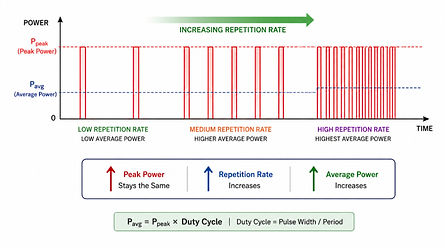
Enhanced Pulsing (also known as Superpulse), is a laser operating mode that uses electronic modulation of the laser drive current or cavity to create pulses with a distinctive waveform. It delivers an extremely high peak power spike right at the leading edge (initial stage) of each pulse, followed by a lower plateau or tail.
Key Technical Terms:
Continuous Wave (CW) Mode: The laser emits a steady, constant output power. This is the baseline for comparison.
Pulsed Mode: The laser output is turned on and off (or modulated) at a repetition rate (pulses per second, Hz), producing discrete bursts of energy. Pulse characteristics include:
Pulse Duration (Pulse Width): Typically microseconds to milliseconds for enhanced pulsing.
Peak Power: The maximum instantaneous power during the pulse—often 5–10× (or more) higher than the maximum CW power of the same laser.
Average Power: Lower than CW because of the off-time between pulses (Average Power = Peak Power × Duty Cycle).
Duty Cycle: Percentage of time the laser is "on" during the cycle.
Rise Time: Very short for the initial spike in enhanced pulsing, enabling rapid energy delivery.
Electronic Modulation: Achieved by rapidly varying the pump current (e.g., in CO₂ or diode lasers) or using Q-switching/gain-switching techniques. This creates the sharp leading-edge overshoot without needing complex optical components.
Thermal Effects:
Vaporization/Ablation: Rapid material removal by turning the surface directly into vapor.
Heat-Affected Zone (HAZ): Minimized because energy input is so fast that heat has little time to conduct into surrounding material.
Explosive Phase Change: At high fluences, the material can undergo superheating leading to explosive ejection rather than slow melting.
How It Works (Basic Mechanism):
In normal CW or standard pulsing, power builds gradually. In enhanced pulsing, the electronics drive the laser hard at the start of each pulse, causing a brief power spike (the "enhanced" or "super" part). This spike delivers intense energy density (fluence, in J/cm²) to the target surface almost instantly. The material reaches vaporization temperature before significant thermal diffusion occurs, leading to clean ablation with minimal melting or charring in the surrounding area.
The rest of the pulse maintains enough power to continue processing while keeping the average power manageable to avoid overheating the laser or workpiece.
Advantages:
Higher peak power than possible in CW for the same hardware.
Reduced heat conduction → smaller HAZ, less distortion, cleaner edges.
Better control over material removal (ablation vs. melting).
Overcomes initial surface reflectivity in some metals.
Applications:
Medical/Surgical Lasers: (especially CO₂ lasers) Precise tissue cutting or ablation with minimal thermal damage to adjacent areas (e.g., ENT surgery, dermatology, gynecology). The superpulse mode reduces charring and speeds healing.
Industrial Materials Processing:
Laser welding of thin sheets or reflective metals (aluminum, copper) — the initial spike breaks through oxide layers or reflectivity.
Laser cutting, drilling, and micromachining: Clean holes or cuts with reduced burrs and heat distortion.
Marking and engraving: Controlled surface vaporization.
Research & Advanced Manufacturing: Processes requiring high-intensity short bursts, such as certain pulsed laser deposition or surface texturing.
In summary, enhanced pulsing turns a laser into a precision "vaporization tool" by front-loading energy delivery, making it ideal wherever you need maximum effect at the surface with minimal collateral heating. It is a standard feature in many industrial and medical CO₂ laser systems.