
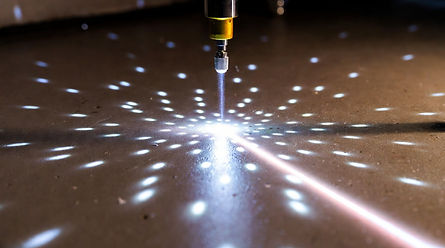
Diffuse Reflection
Diffuse Reflection: (in the context of lasers) refers to the scattering of a laser beam's energy in multiple directions upon interacting with a rough, matte, or non-polished surface. Unlike specular (mirror-like) reflection, where the beam bounces off at a single predictable angle (angle of incidence = angle of reflection), diffuse reflection causes the incident laser light to be redistributed spatially over a wide range of angles. This results in the beam losing its tight collimation and directional coherence, appearing as a "glow" or broadened spot from most viewing angles.
Why It Happens:
At the microscopic level, even seemingly smooth surfaces have irregularities (roughness) larger than the laser's wavelength.
Each tiny facet reflects the beam according to the law of reflection, but because the facets point in random directions, the overall reflected light scatters hemispherically (or nearly so).
Common for materials like paper, painted walls, wood, fabric, matte plastics, ceramics, and most everyday surfaces.
Basic Technical Specifications / Characteristics:
Spatial Distribution: For an ideal Lambertian diffuser (perfect diffuse reflector), the reflected intensity follows Lambert's cosine law: brightness appears the same from all viewing angles, with intensity proportional to cos(θ), where θ is the angle from the surface normal.
Reflectance (ρ): Fraction of incident power reflected (0 to 1). Typical values for visible/near-IR lasers:
White paper/matte paint: 0.7–0.95 (high)
Concrete/brick: 0.2–0.6
Black anodized metal (matte): <0.1 (low)
Scattering Pattern: Often approximated as Lambertian, but real surfaces can be Gaussian, retro-reflective, or mixed. The beam divergence after diffuse reflection is very large (approaching 180° hemisphere).
Polarization: Partially preserved or depolarized depending on surface and wavelength.
Wavelength Dependence: Stronger scattering at shorter wavelengths (Rayleigh/Mie scattering contribution).
Power Density Reduction: Critical for safety — the reflected intensity (W/cm²) drops rapidly with distance and angle compared to the original collimated beam.
Bidirectional Reflectance Distribution Function (BRDF): The formal technical measure used in laser/optics engineering to quantify how light scatters at different incident and viewing angles.
Key Laser-Specific Metrics:
Maximum Permissible Exposure (MPE) calculations for laser safety often assume worst-case diffuse reflection.
Spot size on surface and surface roughness (Ra value in µm) determine the effective scattering.
Applications:
Laser Safety & Hazard Analysis:
Most critical use: Diffuse reflection is why Class 1, 2, and many Class 3R lasers are considered eye-safe at typical viewing distances — the beam spreads out, reducing retinal irradiance.
Used in Nominal Ocular Hazard Distance (NOHD) and Nominal Skin Hazard Distance calculations.
Laser Scanning & 3D Imaging:
LiDAR systems (autonomous vehicles, robotics) rely on diffuse reflection from surfaces to return signals to the detector.
Structured light 3D scanners project laser lines or patterns onto objects and capture the diffuse scatter to reconstruct shape.
Material Processing & Manufacturing:
Laser marking, engraving, and welding on matte surfaces — the diffuse nature helps avoid unwanted specular glints that could damage optics or create safety issues.
Surface texturing to deliberately increase diffuse reflection (e.g., for better laser absorption control).
Projection & Display Systems:
Laser projectors and cinema systems use diffuse screens (white matte or silver screens) to scatter light widely so the image is visible from many seats.
Sensors & Metrology:
Optical position sensors, laser triangulation sensors, and confocal microscopy use diffuse return signals.
Machine vision systems for quality inspection.
Scientific & Medical:
Diffuse reflectance spectroscopy (DRS) to analyze tissue properties, skin, or chemicals non-invasively.
Laser therapy and photobiomodulation where even illumination over an area is desired.
Everyday/Consumer:
Laser pointers on whiteboards or walls (the visible dot is diffuse reflection).
Laser levels and alignment tools.
Diffuse reflection is fundamental to why lasers are usable in real-world environments rather than only in perfectly controlled optical labs. It turns a dangerous, collimated beam into a much safer, widely distributed light source.