
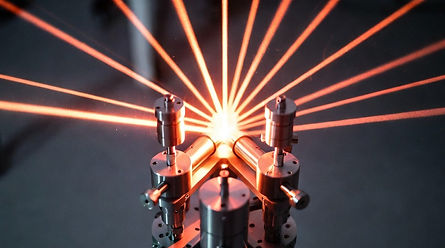
Beam Bender
Beam Bender (or Beam Directors/Steering Devices):
A beam bender, also known as a beam director/steering device or optical deflector, is a hardware assembly or specialized optical component designed to precisely change the direction (and sometimes the position) of a laser beam. The most common and simplest example is a high-quality mirror mounted on a mechanical, motorized, or piezo-electric stage. By tilting or rotating the mirror, the laser beam is redirected via the law of reflection (angle of incidence equals angle of reflection), allowing the beam to be re-pointed anywhere within the system’s field of view without physically moving the laser source itself.
How It Works:
Basic principle: When a laser beam strikes the surface of a mirror at an angle θ, it reflects at the same angle. A small rotation of the mirror by just 1° changes the beam direction by 2°. This “angle doubling” effect makes mirrors extremely efficient for large angular adjustments with minimal mechanical movement.
Advanced variants go beyond simple mirrors:
Galvanometer (galvo) scanners: Fast-moving mirrors driven by electric motors that can steer a beam at thousands of points per second. Used for high-speed marking, engraving, or laser light shows.
Piezo-electric mirrors: Sub-microradian precision positioning using tiny voltage-driven crystals—ideal for scientific applications requiring nanometer-level stability.
Acousto-optic deflectors (AODs) or electro-optic deflectors: Non-mechanical devices that use sound waves or electric fields inside a crystal to diffract and steer the beam with no moving parts (extremely fast, up to MHz speeds, but limited angular range).
MEMS mirrors: Micro-electro-mechanical systems (tiny mirrors on silicon chips) used in compact devices like LIDAR sensors in autonomous vehicles or portable projectors.
Key Uses:
Re-pointing the beam: Instead of moving the entire laser head (which is often heavy, bulky, or fixed), a steering mirror lets the operator or control system instantly redirect the beam to a new target. This is critical in applications where the laser must hit multiple points rapidly or track a moving target.
Folded, compact delivery systems: In real-world laser systems, space is often limited. Straight-line beam paths would require meters of clearance; mirrors “fold” the optical path back on itself, dramatically shrinking the overall footprint.
Example: A 2-meter-long laser cutter can be reduced to a 60 cm × 60 cm enclosure by using three or four steering mirrors to zigzag the beam inside the machine.
Industrial example: CO₂ or fiber laser cutting machines (Trumpf, Bystronic, Amada) use multiple steering mirrors inside the gantry to deliver the beam to the cutting head while the machine itself moves only in X and Y. This keeps the delivery system compact and protects the beam path from dust and vibration.
Medical example: In ophthalmic surgery (e.g., LASIK or femtosecond cataract lasers), the beam is steered by fast galvo mirrors inside a compact handpiece or microscope attachment so the surgeon can treat precise spots on the cornea or lens without repositioning the patient or the laser console.
Scientific example: In large research labs (e.g., LIGO gravitational-wave detectors or ultrafast spectroscopy setups), dozens of steering mirrors fold the beam path across optical tables, routing it through multiple experiments while keeping the entire system on a single 1.2 m × 3 m table.
Consumer/embedded example: Smartphone LiDAR modules (used in iPhones for face ID and AR) or automotive LIDAR units rely on MEMS steering mirrors to scan the laser beam across a wide field of view without any bulky rotating parts.
Additional Important Details:
Mirror specifications matter: For high-power lasers (kW-class), mirrors use dielectric coatings that reflect >99.9 % of the laser wavelength and survive intense heat. Wrong coatings can cause thermal lensing or catastrophic damage.
Precision and stability: Modern systems often combine coarse mechanical steering with fine piezo or voice-coil adjustments to achieve sub-microradian pointing accuracy.
Safety and alignment: Beam steering assemblies usually include beam dumps, safety interlocks, and alignment aids because a mis-directed high-power laser can cause fire, eye injury, or equipment damage in milliseconds.
Control: Most industrial and medical systems are computer-controlled via galvanometer drivers or servo motors, allowing programmable patterns, raster scanning, or real-time tracking.
In short, beam steering mirrors and assemblies are the “steering wheel” of laser delivery systems—simple in concept but engineered to extreme precision so that powerful, expensive lasers can be aimed exactly where needed in the smallest possible package. They are essential in everything from factory-floor metal cutters to delicate eye surgery and cutting-edge scientific instruments.