
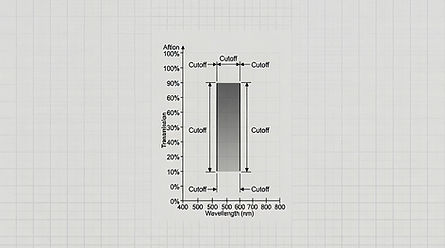
Bandpass Filter
In lasers and photonics, a bandpass filter (also called a band-pass or BP filter) is an optical filter that transmits light within a defined wavelength range (the passband) with high efficiency while strongly attenuating (blocking) wavelengths outside that range on both the short- and long-wavelength sides.
It functions as a wavelength-selective “window,” isolating a desired spectral band and rejecting unwanted light such as ambient background, laser sidebands, amplified spontaneous emission (ASE), fluorescence outside a target band, or other spectral noise.
Technical Information:
Optical bandpass filters are most commonly realized as thin-film interference filters. These consist of multiple alternating layers of high- and low-refractive-index dielectric materials (sometimes with metallic layers in older or specialized designs) deposited on a transparent substrate (e.g., fused silica or glass). The multilayer stack forms one or more Fabry–Pérot cavities. Constructive interference allows transmission near the design wavelength; destructive interference causes reflection/blocking outside the passband.
Key parameters:
Center Wavelength (CWL): Midpoint of the passband (the design wavelength of peak or nominal transmission).
Bandwidth / Full Width at Half Maximum (FWHM): Spectral width measured between the points where transmission drops to 50% of the peak value. Narrowband filters often have FWHM ≤ 10 nm (sometimes < 1–2 nm or even tens of picometers for ultra-narrow designs); broadband versions may span 50 nm or more.
Peak Transmission (T): Maximum transmission within the passband (modern hard-coated dielectric filters commonly exceed 90–95%).
Optical Density (OD) / Out-of-band Blocking: Measure of attenuation outside the passband (e.g., OD 4–6 or higher is common for high-performance filters).
Edge steepness: How rapidly transmission falls at the cut-on and cut-off wavelengths.
Other practical factors: Angle-of-incidence (AOI) sensitivity (the passband shifts to shorter wavelengths at non-normal incidence), temperature stability, polarization dependence, laser damage threshold, and surface quality.
Filters are often classified as soft-coated (older laminated designs) or hard-coated (more durable, environmentally stable, higher laser damage thresholds). Specialized variants include ultra-narrow volume Bragg grating (VBG) or fiber Bragg grating filters, and integrated photonic versions (e.g., microring resonators or arrayed waveguide gratings on silicon photonics platforms).
Performance is typically specified at normal incidence and a standard temperature; the passband can shift with AOI or temperature.
Applications in Lasers and Photonics:
Laser line cleanup / spectral purification: Isolates a single laser wavelength while rejecting ASE, residual pump light, side modes, or broadband background. Common for diode lasers, solid-state lasers (e.g., Nd:YAG, Yb, Tm lines), and fiber lasers.
Fluorescence microscopy and spectroscopy: Separates excitation light from emission bands or isolates specific fluorophore emission peaks, improving signal-to-noise ratio.
Raman spectroscopy: Ultra-narrow bandpass filters (sometimes combined with notch filters) enable measurement of low-frequency Raman shifts close to the laser line.
LiDAR, remote sensing, and environmental monitoring: Selects specific atmospheric or chemical spectral lines while rejecting sunlight or other background.
Machine vision and imaging: Enhances contrast by transmitting only wavelengths of interest (e.g., specific illumination or fluorescence bands).
Optical communications and fiber systems: Wavelength-division multiplexing (WDM) channel selection, noise filtering in amplifiers/lasers, and ASE suppression.
Other uses: Astronomical imaging (isolating spectral lines such as H-alpha), medical diagnostics, flow cytometry, and precision metrology.
Bandpass filters are essential passive components wherever spectral selectivity improves system performance, signal quality, or safety in laser and photonic systems. Selection depends on the required CWL, bandwidth, blocking level, power handling, and environmental conditions.