
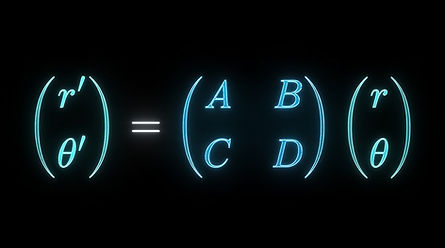
ABCD Matrix
ABCD Matrix (Ray Transfer Matrix)
An ABCD Matrix is a simple but powerful 2-by-2 tool used in laser optics to describe how a single optical element (or a whole system of elements) changes the properties of a laser beam as it passes through. It tracks two key aspects of the beam at any plane: its transverse position (how far off the optical axis it is) and its angle (the direction it is traveling). By multiplying matrices together, you can quickly figure out what the beam looks like after traveling through lenses, mirrors, free space, or any combination of them.
Think of it as a “black-box” description: you put the incoming beam characteristics in one side of the matrix, and the outgoing beam characteristics come out the other side. This works especially well for Gaussian laser beams (the most common type used in labs and industry) under the paraxial approximation (beams that stay relatively close to the optical axis and don’t spread too wildly).
Why It’s Useful:
It turns complicated beam propagation problems into simple matrix multiplication.
You can chain many optical components by just multiplying their individual ABCD matrices in the right order.
It lets you calculate important laser beam parameters such as:
Beam radius (spot size)
Radius of curvature of the wavefront
Location of the new beam waist
Magnification or focusing behavior
Common Examples of ABCD Matrices for Optical Elements:
1. Free-Space Propagation (just traveling through air or vacuum):
The beam drifts a certain distance.
Effect: The position changes based on the angle, and the angle itself stays the same.
Typical use: Predicting how much a laser beam spreads over distance in a lab or between optical tables.
2. Thin Lens (focusing or defocusing lens):
A simple lens that bends rays toward or away from the optical axis.
Effect: It changes the angle of the beam depending on how far from the center it hits the lens, while the position at the lens stays roughly the same.
Common application: Focusing a collimated laser beam down to a small spot, or collimating a diverging beam.
3. Flat Mirror (normal incidence):
A simple reflection off a flat mirror.
Effect: It reverses the direction of travel (flips the sign of the angle) but does not change the beam size or curvature at the mirror surface.
Used in: Laser cavities, periscopes, or beam-steering setups.
4. Curved Mirror (concave or convex):
A spherical or parabolic mirror.
Effect: Similar to a lens but works by reflection. Concave mirrors focus light; convex ones diverge it.
Typical use: Laser resonators (the mirrors that make up a laser cavity) or focusing high-power beams without introducing chromatic aberration.
5. Thick Lens or Lens Sequence:
Multiple lenses or a single thick lens with different surfaces.
You multiply the individual matrices for each surface and the propagation between them.
Example: A telescope made of two lenses — the overall ABCD matrix tells you the magnification and whether the output beam is collimated.
6. Laser Cavity (resonator):
Two mirrors with some distance between them (and possibly lenses or rods inside).
The round-trip ABCD matrix (starting at one mirror, going to the other and back) is used to determine if the cavity is stable and where the beam waist will be inside the laser.
7. Beam Expander:
Usually two lenses arranged to increase the beam diameter while keeping it collimated.
The combined matrix shows how much the beam is magnified and confirms the output remains parallel.
Real-World Scenarios Where ABCD Matrices Are Applied:
Designing a laser cutting or engraving machine: You use the matrix method to place lenses so the beam stays focused on the workpiece even as the head moves.
Building a stable laser cavity: Engineers calculate the ABCD matrix of the entire round trip to ensure the beam doesn’t walk off the mirrors or become unstable.
Fiber coupling: Matching the laser beam size and divergence to the tiny core of an optical fiber by choosing the right focusing lens.
Microscopy or medical lasers: Keeping precise control of spot size at different depths inside tissue or samples.
Mode matching: Adjusting the beam so it perfectly matches the mode of another laser or an optical resonator.
In short, the ABCD Matrix is the “Swiss Army knife” of laser beam optics. Instead of tracing thousands of rays or solving complex wave equations, you use this compact matrix approach to quickly understand and design how your laser beam will behave through any optical setup.